Below are a list of my projects.
BIRDS-CDH
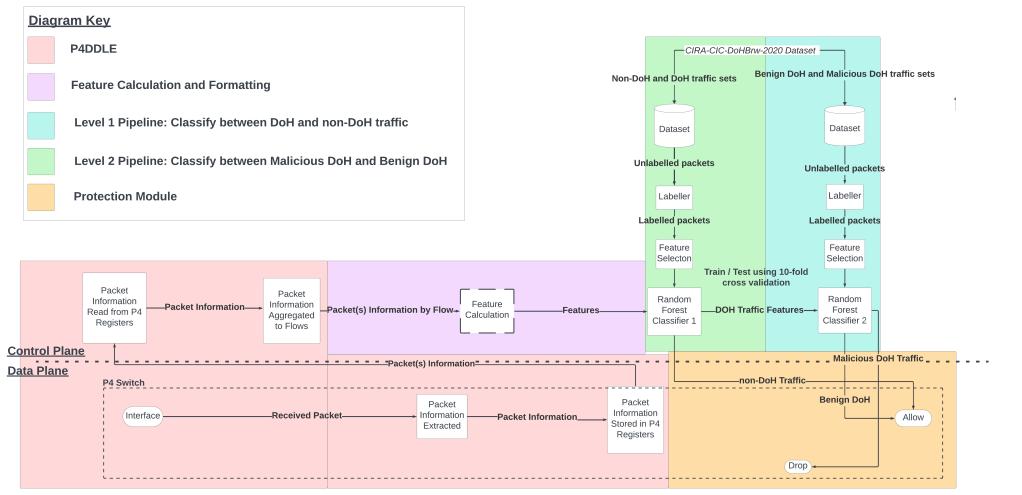
The DNS over HTTPS (DoH) protocol is increasingly popular for addressing privacy issues in plain-text Domain Name System (DNS) queries. However, its similarity to regular HTTPS traffic presents challenges for network administrators, as it can be exploited for data exfiltration and Command and Control (C2) activities. Current detection methods for malicious DoH traffic often overlook computational scalability at the enterprise level.
In this project, I developed a Machine Learning (ML) pipeline that utilizes the computational power of network switches for feature extraction, reducing the load on the control channel by processing data in the data plane. This approach aims to decrease classification latency, leveraging the efficiency of Programming Protocol-independent Packet Processors (P4) in packet processing. The solution maintains high classification standards while enhancing scalability, providing a more robust mechanism for detecting malicious DoH activities in enterprise environments.
Barry’s Intelligent Real-Time Detection System for Classification of DNS over HTTPS (BIRDS-CDH) is the world’s first RF-based pipeline for malicious DoH detection, designed to train, test, and evaluate RF models in an online environment. It leverages resource-efficient traffic feature extraction in the data plane, enabled by P4.
As the paper is pending publication, the full research article and code base must remain confidential until release.
Special thanks to Dr. Sandra-Scott Hayward from CSIT for supervising this project.
FUZE
This project was born from my previous work on a raspberry pi network monitor. It won the Queen’s University Dragon’s Den and was a finalist in INVENT NI Student competition.
The FUZE is a user-friendly network security device. It sits between a PC and the network and monitors packet transmission between computers. If a computer is compromised, the FUZE will cut the connection between the infected computer and the rest of the network. The FUZE has blown. A touch screen displays details of the incident and, where applicable, a method to fix the problem / attack vector.
The FUZE is designed with simplicity first. It is simple to set up, using a plug and play methodology. It also provides a more physical and tactile aspect to cybersecurity.
A pitch video can be seen below:
I also had the pleasure of attending Plexal’s Cyber Runway programme. A boot camp to help budding entrepreneurs, graduates and spinouts get their business off the ground and build connections.
Educational YouTube Channel
Since my A-Level project was exemplary, my secondary school IT teacher asked if I could create a YouTube channel to help the next cohort of A-Level students. Radiant Coding was born, and has at time of writing 673 subscribers.
It primarily covers the Python Tkinter framework, and how to integrate databases, email accounts and graphing.
Code downloads for all the tutorials can be found here.
Raspberry Pi Network Monitor
Predecessor to the FUZE, the Raspberry Pi Network Monitor was my project for the “Computer Science Challenges” module at QUB.
The concept is a raspberry pi which can sit in a network and detect whether or not a DDOS attack is occurring. This was my first foray into Machine Learning and was quite a fun to work on.
A-Level Scout RDMS System
As part of the Computer Science A-Level (WJEC) I had to create a RDMS system from scratch using python. All data integrity had to be handled by the application itself, and no third party APIs were allowed. Having not being taught how to code in the OOP paradigm, this ended up being quite a laborious project, however it holds a special place in my heart as a great introduction to Software Engineering.
 Barry Cheevers